The beach file
A beach isn't one surface — it's backshore, berm, beach face, swash zone, towel, cooler lid, and chair, stacked into a single afternoon, and each one tips a drink for a different reason. Here's what's actually happening under a leaning can, zone by zone, and what a fix needs to account for instead of working around.
Walk from the lot to the water and a drink crosses more distinct ground than it will anywhere else in a day. The dry sand above the last high-tide line is the backshore, cut off from the wetter beach below by the berm — the low ridge each wave's reach builds at its farthest point. Past the berm, the beach face slopes toward the water, and the strip at the bottom of that slope, alternately covered and exposed by every wave's run-up and backwash, is the swash zone. Nearer the waterline the sand firms into hard-pack, easier to stand on than the loose sand above it, and somewhere in that sequence a scatter of shells and seaweed marks the wrack line — the visible record of how far yesterday's high tide actually got.
Each zone tips a drink for its own reason. Backshore sand keeps re-settling under weight. The beach face is sloped by definition. The swash zone is temporary by definition, on a clock whether or not anyone's watching the water. Hard-pack solves the slope and the loose grain, but not the clock. None of it is one long run of bad luck — it's just what a beach's own geography offers, zone by zone, none of it built to hold a drink upright.
Sand under a narrow object doesn't fail all at once. As a can's weight presses down, the grains directly underneath slip and repack at a different density than the grains just outside that footprint, so the socket the can sits in keeps quietly deepening on one side before the other. That uneven settling is what shifts the can's center of gravity past the edge of its own base — not one dramatic event, but a slow, one-sided sinking that a shifting towel or nearby foot traffic only speeds up.
Heat compounds it. In direct sun, beach sand commonly runs to around 100°F when the air itself is only about 75°F, passes 120°F once the air reaches the 90s, and on the hottest, clearest days climbs into the 130s and even 140s — one extreme-heat reading hit 137°F on Miami's South Beach. Human skin starts registering pain around 111°F and can take a first-degree burn near 118°F, which is the actual physical basis behind the barefoot warnings coastal towns post on the worst afternoons. A drink resting directly on that surface is being heated from its base the entire time it sits there, well before anyone notices the lean happening at the same time.
The sea breeze that fills in most beach afternoons isn't random — it's the direct result of land and water heating at different speeds under the same sun. Sand and pavement warm up fast; the ocean right next to it barely budges. Once that temperature gap gets large enough, the warm air rising over the hot land pulls cooler air in off the water behind it, and that inbound flow is what beachgoers feel arrive as the breeze picking up. It tends to build through the middle of the afternoon into early evening — close to the same window a beach crowd usually peaks.
That's the wind that catches a light can standing upright on a towel or a cooler lid, and it isn't a rare gust that happened to find one unlucky drink. It's a wind that shows up close to on schedule on most clear days at the coast, for a specific, ordinary reason — worth knowing before reaching for a flip-flop or a sunscreen bottle to hold something down.
A sand spike — a stake with a cup ring on top, pushed or twisted into the ground — runs into the same problem it's supposed to solve. Its grip depends on the surrounding grains holding the shaft firmly enough to resist a bump, and that's exactly the kind of grip loose backshore sand doesn't reliably offer; sellers of these stakes note themselves that they anchor better in firm dirt than in shifting beach sand. The instability tipping the can in the first place is the same instability loosening whatever's supposed to be holding it upright.
A folding chair's built-in armrest holder fails for two separate reasons, not one. The molded plastic ring or mesh pocket is sized for a standard can, so a wider insulated tumbler simply doesn't fit the opening — a dimension problem, not a stability one. Separately, a season of UV and salt exposure cracks the plastic and stretches the mesh, so even a can that used to fit starts sitting looser than it did new. One is a design mismatch, the other is material fatigue, and either alone is enough to send a drink back down into the sand.
A koozie and a portable folding table each solve one problem apiece. The koozie slows how fast a can warms; it does nothing about the narrow base still standing on sand or a towel underneath it. The table lifts a drink off the ground entirely, but its thin legs sink unevenly into soft sand, tilting the whole tabletop so anything on it drifts toward the low side as the afternoon goes on — a bigger surface, the same old problem underneath.
Every one of those fixes asks a small point of contact — a can's rim, a stake's tip, a table leg — to resist a tilt on ground that's loose, sloped, hot, or moving. A working answer has to spread that load instead of concentrating it: a footprint wide enough to distribute weight across many grains rather than pressing one small socket into the sand, so the re-settling that tips a can has less leverage to work with.
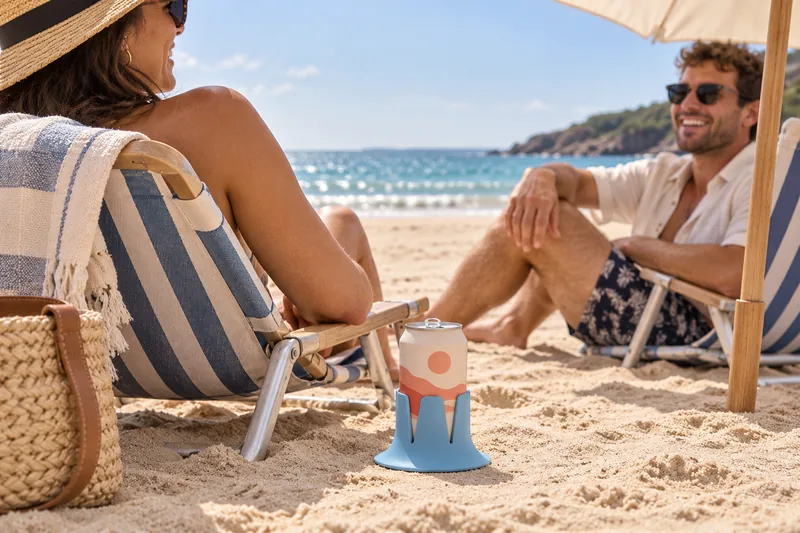
The grip matters as much as the footprint. Holding a container by the sides of its base — the bottom inch, where there's the least leverage for a tip to start — keeps it from rolling free the way an unsecured can skates across a towel or a cooler lid. And because nothing at the beach holds still for long, the base itself needs enough flex to settle back level when the sand resettles, a towel corner lifts, or a gust catches it, instead of staying rigid against ground that's already moving. That combination — wide footprint, low grip, flex to settle back — is what lets a base resist tipping on ground that never really holds still: a container base 2 to 3 inches across settles in fully, and the fins flex to seat a slightly wider base as well, as far as 3.15 inches, before there's nothing left to grip.
None of this is beach-specific magic — it's matching a footprint to ground that was never going to sit flat, hot, or still for very long. Give a drink that kind of base, and the sand, the wind, and the tide stop being something to manage.
Get one — ships freeCheckout happens at steadilabs.com — that's the maker's own store.